
Black & White Peptides Ltd. Registered in England & Wales, company number 16876162.

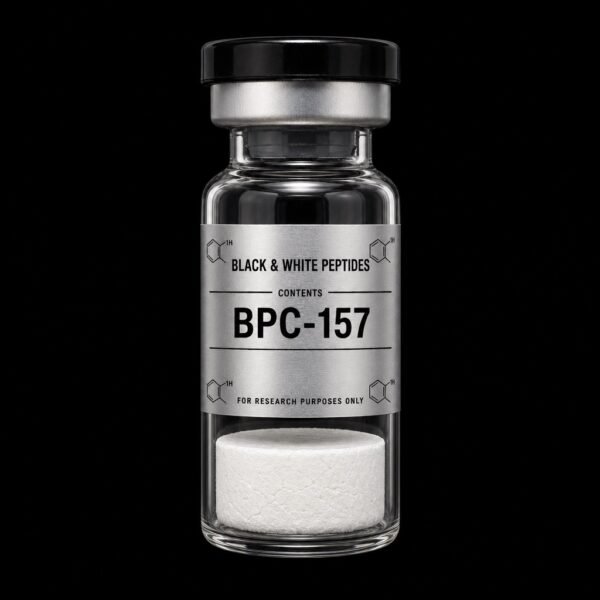
BPC-157.
Price range: £31.00 through £55.00
A 15-amino-acid synthetic peptide from a partial sequence of human gastric juice protein. One of the most cited regenerative-research peptides.
What’s in your box
Key Features
- Premium Research Peptides
- Secure Bank Payments
- Satisfaction Guarantee
- Worldwide Shipping
- Money Back Guarantee
Quick answers to the most-asked questions
Everything researchers usually message us about, answered on the page.
- 🛡 Do you test your products? Every batch is verified through Janoshik HPLC testing.
Yes – every batch. Every product we supply is independently HPLC-verified by Janoshik Analytical, a Czech specialist peptide-analysis laboratory unaffiliated with us. Reported purity is consistently above 99%.
Where a Janoshik report has been issued for the current batch, the printed Certificate of Analysis is supplied with the order. Otherwise the verification record is published on our Purity page.
Every COA carries a unique verification key you can authenticate against Janoshik’s own portal at janoshik.com – so you don’t have to take our word for it. We’re the only UK supplier writing publicly about how to read these reports: how to read a Janoshik HPLC report ›
- How to mix BAC + powder
- Wipe the vial top. Use one of the alcohol prep wipes from the box. Let it dry.
- Draw 2 mL BAC water. Use one of the insulin syringes. Insert the needle through the rubber stopper of the BAC water vial.
- Inject the BAC slowly down the inside wall of the peptide vial. Don’t squirt directly onto the powder.
- Swirl gently. Don’t shake. Wait 30 seconds for full dissolution. Refrigerate.
Use the reconstitution card on the inside of the box lid as your reference next time.
- How to use the pen
- Attach a fresh needle. Wipe the needle end of the pen with an alcohol prep wipe. Screw a foil-wrapped needle from the box onto the threaded tip.
- Prime the needle. Dial up 1 click, point the needle upwards, press the dose button. A drop of solution at the needle tip confirms the pen is primed and any air is expelled.
- Dial your research dose. Each click on the dose dial delivers a fixed increment. Click resolution is typically 0.5–1 mg per click depending on calibration; the dose window shows your total dialled dose. For example, a 6 mg research dose is roughly 6–12 clicks.
- Administer at the route used in published research. Cohort protocols use subcutaneous administration (abdomen, thigh, upper arm). Hold for ~6 seconds before withdrawing.
- Discard the needle in a sharps container. Cap the pen and return to refrigerated storage.
One pen lasts the number of doses shown in the protocol cards above for your selected size. When it’s empty, drop a refill cartridge into the same pen body – price for your size is in the calculator at the top.
Research use only. Procedure drawn from published cohort protocols. We do not provide medical or human-use guidance.
- Storage
Lyophilised vial: stable 24+ months at 2–8 °C, sealed and protected from light. Don’t freeze.
Reconstituted (after BAC water): ~30 days at 2–8 °C. Don’t shake. Keep in original glass vial. Discard if cloudy or discoloured.
BAC water bottle: 30 days once opened, refrigerated.
- Administration in research
Published research literature on BPC-157 uses subcutaneous administration in the abdomen, thigh or upper arm in human pharmacokinetic and Phase 2 / 3 studies. Researchers rotate sites between administrations to reduce local tissue stress.
Research use only. The route information above is drawn from published peer-reviewed literature for context. We do not provide human-use guidance, dosing protocols, or administration instructions.
Reference: Sikiric et al. 2018
- What should my dose be?
The clean answer: follow the protocol cards above. Published research literature on BPC-157 uses titration – start low, step up at fixed weekly intervals. The phase highlighted in green is where most published research cohorts settle for ongoing study. buy BPC-157 regenerative peptide
If you’re new to this compound: start at Phase 1 (the lowest dose shown above) for the full duration of that phase, then step up to the next. The titration is what limits the GI side effects reported in the trial – don’t skip it.
If you’ve used this compound before: you already know which phase you’re at. Tap the phase tabs above to see exactly what your dose costs at your selected vial or pen size, plus how long it will last.
If your protocol is non-standard: WhatsApp us before you order. We help researchers work out custom schedules every day and will tell you which size makes most sense for the cadence you’re running. Real human reply, not a chatbot. buy BPC-157 regenerative peptide
Research use only. The dosing described is drawn from published peer-reviewed cohort literature for context. We do not provide medical or human-use guidance. If you are evaluating this compound for human use, consult a qualified medical practitioner. Reference: Sikiric et al. 2018
Quick Reference
| Compound name | BPC-157 (Body Protection Compound-157) |
| Sequence | Gly-Glu-Pro-Pro-Pro-Gly-Lys-Pro-Ala-Asp-Asp-Ala-Gly-Leu-Val |
| Amino-acid count | 15 (pentadecapeptide) |
| Molecular formula | C62H98N16O22 |
| Molecular weight | ~1419.5 g/mol |
| CAS number | 137525-51-0 |
| Parent molecule | Fragment of BPC (Body Protection Compound), a protein isolated from human gastric juice |
| Typical format | Lyophilised powder in sealed vial; reconstituted in bacteriostatic water for laboratory work |
| Typical research purity | >99% by HPLC (verified batch-by-batch by Janoshik Analytical) |
Background
BPC-157 is the designation given to a 15-amino-acid fragment of Body Protection Compound, a protein originally isolated from human gastric juice by Sikiric and colleagues. It was proposed in the early 1990s that this fragment retained the stability and activity attributed to the parent compound in cell-signalling research models.
Unlike many naturally occurring peptides, BPC-157 has an unusual stability profile in aqueous solution and has not required carrier molecules or lipid modifications to remain intact during in-vitro work. This has made it one of the most widely studied short peptides in the preclinical literature over the last three decades.
What the Literature Describes
The published preclinical literature characterises BPC-157 primarily in three research areas. The summary below is drawn from peer-reviewed studies; none of it constitutes a therapeutic claim for human use. buy BPC-157 regenerative peptide
- Connective-tissue and tendon models. Rodent studies examining the behaviour of tendon-derived fibroblasts in the presence of BPC-157 form one of the most frequently cited threads in the literature.
- Gastrointestinal cell-signalling models. Given the compound’s origin as a fragment of a gastric juice protein, a substantial body of work investigates its effects on intestinal epithelium and related signalling pathways in rodent models.
- Nitric oxide and vasomotor signalling. Several research groups have explored BPC-157 interactions with the NO system in preclinical cardiovascular models.
For a representative entry-point into the PubMed record, search terms such as “BPC-157 tendon”, “BPC-157 gastric” and “pentadecapeptide BPC” return the core publications by Sikiric’s research group and subsequent independent confirmations.
Compare BPC-157 with Related Compounds
- Compare BPC-157 vs TB-500 – side-by-side mechanism, pricing and lab handling.
Key Literature References
- Sikiric P et al. Stable gastric pentadecapeptide BPC 157 – preclinical reviews. (PMID: 29360469) →
References are independent peer-reviewed sources. Black & White Peptides Ltd is not affiliated with these publications.
| Size | 10mg |
|---|---|
| Format | Pen, Vial |
Related products
-
ACE-031.
Price range: £56.00 through £65.00 Select options This product has multiple variants. The options may be chosen on the product page -
GHK-Cu.
Price range: £51.00 through £75.00 Select options This product has multiple variants. The options may be chosen on the product page -
Ara-290 (Cibinetide).
Price range: £46.00 through £70.00 Select options This product has multiple variants. The options may be chosen on the product page -
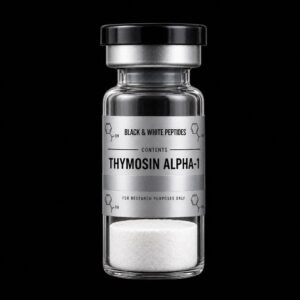
Thymosin Alpha-1.
Price range: £56.00 through £95.00 Select options This product has multiple variants. The options may be chosen on the product page
Reviews
There are no reviews yet.